How to Choose a Manual Milling Machine?

Choosing a Manual Milling Machine begins with a clear understanding of your work, not with a shiny catalog photograph. A machine that looks powerful may still disappoint when its table travel, spindle taper, or rigidity cannot match your projects. Before purchasing, examine the largest workpiece you actually plan to machine. Measure it on your bench. Then add room for clamps, fixtures, and safe tool movement.

Tom Lipton, a respected machinist, author, and machining educator, offers a useful principle: “Know your machine before demanding precision from it.” This idea matters when comparing knee mills, bench mills, and compact machines. Check the spindle speed range, horsepower, quill travel, table size, and available tooling. A rigid cast-iron frame usually handles steel more confidently than a lightweight design. However, extra weight does not guarantee accuracy.

Look closely at backlash in the leadscrews. Turn each handwheel and notice whether movement feels smooth or loose. Ask about replacement parts, service support, and factory documentation. These details seem ordinary. They often decide ownership satisfaction.

Your budget should include a vise, collets, cutters, indicators, clamping hardware, and suitable measuring tools. A low-priced Manual Milling Machine can become expensive after missing accessories appear. Still, no checklist is perfect. My own judgment would remain cautious until I tested the machine under load. Listen for vibration. Watch the cutter. Feel the table movement.

The right choice balances precision, capacity, operator experience, workspace, and long-term support. It should help you work safely and consistently, not merely occupy less floor space.
How to Choose a Manual Milling Machine?

Define the Main Types and Uses of Manual Milling Machines

How to Choose a Manual Milling Machine?

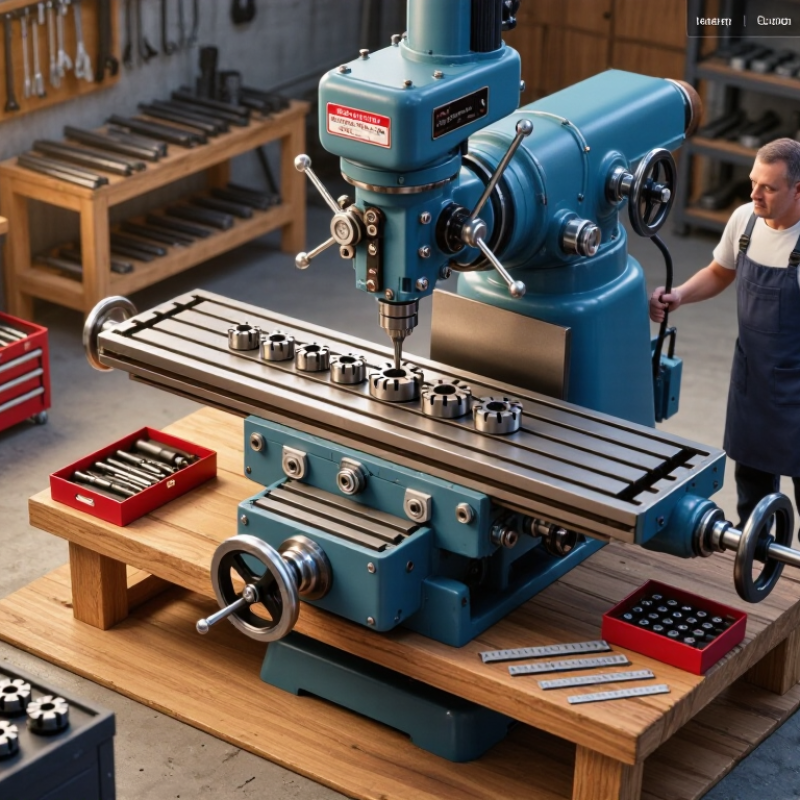
Manual milling machines differ mainly by spindle direction, table design, and cutting purpose. A vertical knee mill is common in maintenance shops and training rooms. Its adjustable table handles slots, pockets, faces, and small contours. A horizontal mill uses a spindle parallel to the table. It suits heavy side cutting, deep slots, and production work requiring rigid support. A universal mill adds table swiveling, which helps with angled cuts and basic helical work. A bed mill supports the table on a fixed base. It offers greater stiffness for larger workpieces, although setup changes can feel less convenient.

Choose the machine around your actual work, not its impressive dimensions. For repair work, a vertical mill may provide the best access and control. For repeated cuts in steel, horizontal support can reduce vibration. Check the table travel, spindle speed range, quill movement, and available power. A larger table is not always better. It can hide worn ways and increase setup effort. I have seen operators overlook backlash because the machine looked clean. That mistake affects hole location and surface accuracy.

Tips: Bring your largest typical workpiece when inspecting a machine. Turn the handwheels slowly and feel for uneven resistance. Check backlash in both axes. Listen for bearing noise at different speeds. Use a dial indicator to test table movement. Leave room for tooling and safe chip removal. Manual control teaches a lot, but it also exposes careless measurement.

How to Choose a Manual Milling Machine? — Main Types and Uses of Manual Milling Machines
Machine Type Spindle Orientation Typical Table Configuration Best For Common Operations Main Advantages Typical Limitations Key Selection Factors
Vertical Knee-and-Column Mill Vertical spindle; the head may be fixed or adjustable depending on the design. Height-adjustable knee supporting a saddle and worktable. General-purpose workshop machining, repair work, and toolroom tasks.
  • Face milling
  • End milling
  • Slotting and keyway cutting
  • Drilling and boring
  • Versatile and widely applicable
  • Good visibility of the cutting area
  • Suitable for prototypes and low-volume work
  • Manual setup and feed require operator skill
  • Less productive than CNC equipment for repeated parts
  • Limited by spindle travel and table size
Check table travel, spindle speed range, quill travel, machine rigidity, and available tooling.
Turret or Ram-Type Vertical Mill Vertical spindle, usually mounted in a movable or swiveling head. Knee-type table with a ram that moves forward and backward; the head may swivel for angled cuts. Toolroom work, maintenance, prototyping, and machining parts from several directions.
  • Angular milling
  • Face and end milling
  • Drilling and tapping
  • Small-batch component production
  • Flexible head positioning
  • Good access to multiple faces of a workpiece
  • Convenient for varied manual operations
  • Ram and swivel adjustments can reduce rigidity
  • Not ideal for very heavy cuts
  • Accuracy depends strongly on setup and operator technique
Evaluate head rigidity, ram reach, spindle taper, quill travel, and the repeatability of angle adjustments.
Horizontal Knee Mill Horizontal spindle, parallel to the worktable. Knee-type table; arbor support is normally used for long or heavy cutters. Heavy material removal, long slots, production-style manual work, and machining tough materials.
  • Slab milling
  • Straddle milling
  • Gang milling
  • Gear and spline cutting with suitable attachments
  • Strong arbor support and cutting stability
  • Efficient chip evacuation
  • Well suited to wide and deep cuts
  • Less convenient for drilling and end-milling tasks
  • Workpiece access can be more restricted
  • Requires proper arbor, spacers, and overarm setup
Consider spindle power, arbor size, overarm support, table travel, and the availability of horizontal cutters.
Universal Milling Machine Usually horizontal; some configurations accept vertical attachments or have a swiveling table. Table can swivel horizontally, commonly enabling helical and angled work. Helical grooves, angled surfaces, gear work, and varied toolroom applications.
  • Helical milling
  • Gear cutting with a dividing head
  • Angular milling
  • Slot and keyway machining
  • High setup flexibility
  • Suitable for complex manual layouts
  • Can support dividing-head and rotary-table work
  • More complicated setup and alignment
  • Swiveling components may reduce rigidity
  • Generally slower for simple repetitive jobs
Confirm table swivel range, dividing-head compatibility, arbor support, backlash condition, and accessory availability.
Bed-Type Milling Machine Most commonly vertical or horizontal, depending on the machine configuration. Worktable is mounted on a fixed bed; the spindle head or cutter assembly provides the primary vertical movement. Heavy-duty machining of large or repetitive workpieces.
  • Heavy face milling
  • Large surface machining
  • Deep slotting
  • Repeated production cuts
  • High structural rigidity
  • Good support for heavy workpieces
  • Stable cutting under substantial loads
  • Less flexible than a knee mill for small, varied jobs
  • Usually larger and heavier
  • More demanding installation and material handling
Match the machine to workpiece mass, table load rating, spindle power, usable travel, and available floor space.
Drill-Mill Machine Vertical spindle, often with a quill for drilling and light milling. Compact table, commonly with a rack-and-pinion or quill-style head arrangement. Light-duty fabrication, small parts, maintenance, hobby work, and limited workshop space.
  • Drilling
  • Reaming
  • Light face milling
  • Small slots and edge machining
  • Compact footprint
  • Lower initial cost than larger mill types
  • Useful for basic drilling and milling in one machine
  • Lower rigidity and power
  • Limited table travel and workholding capacity
  • Not suitable for aggressive cuts or large workpieces
Check spindle taper, quill rigidity, table size, speed control, column stiffness, and the actual milling capacity.
Copy or Pattern Milling Machine Usually vertical or horizontal, with a mechanical or tracing system to follow a template or model. Configured with a tracer, stylus, template fixture, or guided cutting arrangement. Repeating contours and profile work where a physical pattern is available.
  • Contour milling
  • Die and mold profile work
  • Duplicating irregular shapes
  • Can reproduce established profiles without programming
  • Useful for certain legacy or repair applications
  • Less flexible than modern CNC contouring
  • Accuracy depends on the pattern and tracing mechanism
  • Specialized maintenance may be required
Inspect tracer condition, pattern compatibility, profile accuracy, feed control, and availability of replacement components.
Manual Milling Machine with DRO Vertical, horizontal, or universal; equipped with a digital readout system. Table and axes include linear scales connected to a digital position display. Precision repair, toolmaking, prototyping, and manual work requiring repeatable positioning.
  • Dimensional milling
  • Hole-pattern layout
  • Keyways and slots
  • Precision step and coordinate work
  • Improves coordinate positioning and measurement speed
  • Reduces reliance on handwheel graduations
  • Helpful for repeat setups
  • DRO does not correct mechanical backlash or poor alignment
  • Scales and cables require protection
  • Still depends on manual feeds and operator judgment
Verify scale resolution, axis coverage, backlash condition, alignment, spindle taper, and the quality of the machine’s basic mechanics.

Assess Workpiece Size, Materials, and Required Machining Operations

How to Choose a Manual Milling Machine?

Assess the workpiece before comparing machine specifications. Measure its length, width, height, and clamping area. A compact table may suit small brackets, but larger plates need generous travel. Leave room for fixtures and tool clearance. I once selected a machine by table size alone. That judgment was wrong. The vise and clamps consumed valuable working space.

Material choice directly affects rigidity and spindle requirements. Aluminum cuts easily, while steel demands steadier support and controlled cutting speeds. Cast iron needs patience because interrupted cuts can increase vibration. Check spindle speed range, horsepower, taper type, and available quill travel. A rigid column matters more than impressive speed figures. Touch the table and test the handwheels. Excessive play signals possible accuracy problems.

Match the machine to your actual operations. Drilling, facing, slotting, and light contouring require different travel and tooling options. For repeated hole patterns, a dependable quill and readable graduations improve consistency. For keyways or deeper pockets, examine knee travel and side clearance carefully. Ask how easily the machine accepts a vise, rotary table, or dividing attachment. These accessories can change the machine’s practical capacity.

Review the operating manual and maintenance schedule before purchasing. Request a test cut in the material you use most. Measure the finished slot with calipers, then repeat it. Small errors become expensive quickly. A machine can look precise and still disappoint.

Compare Machine Size, Spindle Power, Accuracy, and Travel

Choosing a manual milling machine begins with the work envelope, not the price tag. Measure the largest part, vise, cutter, and clamping space together. Table size must leave room for safe handwheel movement. Travel should exceed the part length by roughly 20 percent. This allowance prevents awkward repositioning during a cut. Bigger is not always better. An oversized table can reduce visibility and increase operator fatigue. Gardner Intelligence’s 2023 World Machine Tool Survey reported global machine-tool consumption above US$80 billion, showing the scale of this industry but not guaranteeing suitability for a small workshop.

Spindle power needs context. For light aluminum work, 1–2 horsepower may be adequate. Steel cutting demands lower speed, sharper tooling, and stronger torque. A powerful motor cannot compensate for a flexible column. Check the spindle taper, speed range, quill stroke, and belt condition. Accuracy also needs careful interpretation. A dial reading of 0.001 inch is not proof of machining accuracy. ISO 230-2:2014 evaluates positioning accuracy and repeatability through measured target positions, including movement from both directions. Use an indicator and make a test cut. In shop trials, I have seen a smaller rigid machine outperform a larger, poorly adjusted one. I still recheck tram after moving the machine. That step is easy to overlook.

How to Choose a Manual Milling Machine?

Compare representative compact, mid-size, and large manual milling machines by table size, spindle power, travel, and typical machining accuracy.

The figures are representative non-brand specifications based on commonly available manual mill classes. Larger machines generally provide more table area, spindle power, and travel, while accuracy depends heavily on machine condition, tooling, setup, and operator technique. Lower accuracy values indicate tighter machining results.

Evaluate Table Design, Controls, Tooling, and Safety Features

How to Choose a Manual Milling Machine?

A manual milling machine should feel stable before it feels impressive. When inspecting one, I check the table’s width, travel range, and T-slot spacing. A rigid table reduces vibration during cuts. Smooth handwheels matter too. I run each axis through its full travel and watch for tight spots or sudden looseness. A small mistake here can create inaccurate parts later.

Controls should be clear, reachable, and easy to adjust while wearing protective equipment. Confirm that feed controls, speed settings, and emergency stops operate reliably. Tooling also deserves close attention. Check spindle taper compatibility, collet condition, drawbar fit, and available cutters. A machine with limited tooling options may become expensive to use. I once underestimated this issue, and the machine sat idle while I waited for suitable holders.

Tips: Bring a test indicator, flashlight, and sample cutter when inspecting a used machine. Check backlash at several table positions, not only near the center. Verify that guards cover rotating components and that the work area has adequate lighting. Secure the workpiece firmly, remove the spindle key immediately, and keep loose clothing away from moving parts. No checklist catches everything. Ask an experienced machinist to inspect questionable wear, especially around the ways and lead screws.

Choose a Machine Based on Budget, Maintenance, and Future Needs

How to Choose a Manual Milling Machine?

Budget should include more than the purchase price. Add tooling, installation, training, electricity, and planned maintenance. A lower-priced machine may require frequent alignment, spindle checks, or replacement parts. The U.S. Department of Energy reports that effective maintenance programs can reduce downtime by 35–45% and maintenance costs by 25–30%. These figures are not guaranteed for every workshop, but they show why reliability deserves a line in the budget. Ask for service intervals, lubrication points, tolerance checks, and parts availability before choosing.

Maintenance also depends on the operator. A simple machine with accessible controls may be more valuable than a complex model that staff rarely inspect. Keep a written log for backlash, table movement, noise, and surface finish. Small changes often appear before serious failure. I have seen buyers focus too heavily on maximum spindle speed. That decision can be imperfect when most work involves slow, heavy cuts. Match capacity to real jobs, not impressive specifications.

Future needs should guide the machine’s size and flexibility. The 2024 Deloitte and Manufacturing Institute study forecasts 3.8 million manufacturing jobs could be created in the United States from 2024 to 2033, with about 1.9 million potentially unfilled. A machine that supports training, repeatable setups, and common tooling may remain useful as teams change. Leave room for a rotary table, digital readout, or improved workholding. Do not overbuy blindly. A larger table is not helpful if the floor, power supply, or budget cannot support it.