China Best Kitchen Sink Double Bowl Manufacturers
Choosing among China Best Kitchen Sink Double Manufacturers requires more than comparing prices and polished product photos. A dependable supplier should show practical experience, stable production, and clear quality records. Buyers need to examine stainless steel grades, bowl depth, welding quality, sound insulation, and drainage performance. These details affect daily use more than attractive images.
Kitchen designer Susan Serra, CKD, has said, “The kitchen is the heart of the home.” Her observation explains why a Kitchen Sink Double deserves careful selection. Two bowls can separate washing from rinsing, handle large cookware, and support busy family routines. However, poor design can create standing water, sharp edges, or difficult cleaning. Small flaws become frustrating quickly.
Reliable Chinese manufacturers usually provide material certificates, inspection procedures, sample testing, and honest production timelines. Look for 304 stainless steel options, consistent thickness, smooth corners, and properly finished drain openings. Factory visits or independent inspections can strengthen confidence. Ask about packaging, replacement parts, customization, and after-sales communication.
No factory is perfect. Even experienced suppliers may miss a finish defect or delay one shipment. That is why verification matters. A supplier’s response to problems often reveals more than its catalog. Buyers should compare several factories, request physical samples, and test them under realistic conditions. Water should drain cleanly. The bowls should remain stable. The surface should resist ordinary kitchen wear.
This guide examines China-based Kitchen Sink Double manufacturers through product quality, manufacturing experience, customization ability, certifications, and customer support. It also recognizes an uncomfortable truth: the lowest quotation may create the highest long-term cost. Evidence should lead the decision, not attractive promises.
Double Bowl Kitchen Sinks: Definition and Core Features
China Best Kitchen Sink Double Bowl Manufacturers
Double Bowl Kitchen Sinks: Definition and Core Features
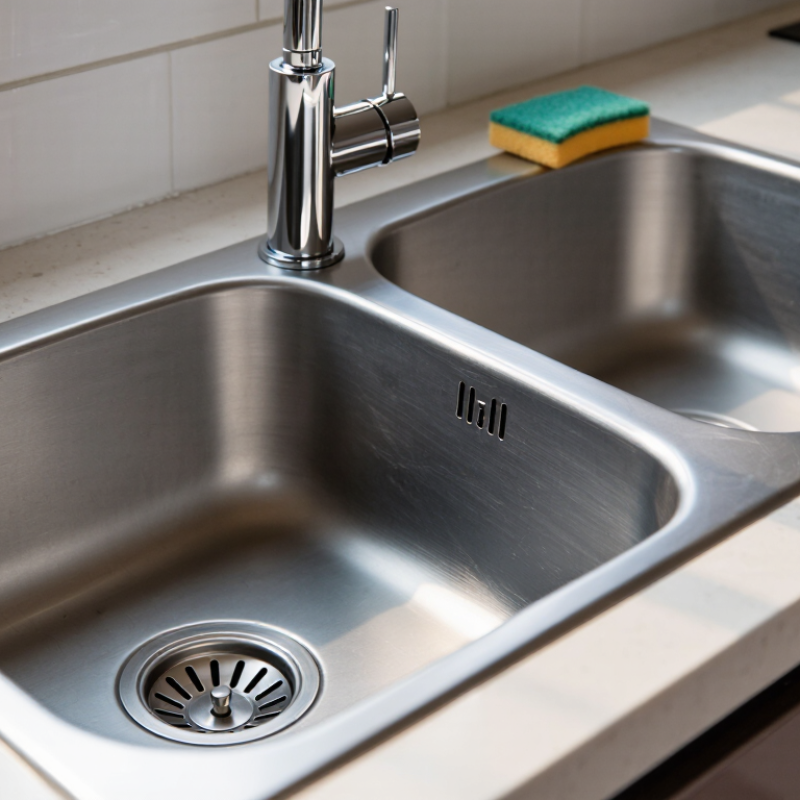
A double bowl kitchen sink has two separate basins within one countertop unit. A central divider separates washing, rinsing, or food preparation. Common configurations include equal bowls, a larger bowl with a smaller companion, and offset depths. The structure supports practical kitchen routines, especially when one basin holds soaking dishes while the other remains available.
Core features include stainless steel construction, sound-deadening pads, rounded corners, and rear-positioned drains. A 50/50 layout offers balance, but a 60/40 design may suit large cookware better. Bowl depth matters too. A deep basin can hide dishes, yet it may strain shorter users. This detail is often overlooked.
Fortune Business Insights estimates the global kitchen sink market could grow from about USD 3.47 billion in 2023 to USD 5.16 billion by 2030. Its reported 5.86% compound annual growth rate reflects rising renovation and residential construction demand. However, market reports use different product categories, so comparisons require caution. A sink is not only a visual fixture. It affects countertop planning, plumbing access, cleaning effort, and daily water movement.
Tips: Measure cabinet width, bowl depth, divider height, and drain placement before ordering. Check whether your largest pan fits comfortably. Also, test the faucet reach. A beautiful sink can still perform poorly.
China’s Double Bowl Sink Manufacturing Industry
China Best Kitchen Sink Double Bowl Manufacturers
China’s Double Bowl Sink Manufacturing Industry
China’s double bowl sink industry is shaped by stainless steel capacity, export experience, and demanding kitchen layouts. World Stainless reported approximately 58.4 million tonnes of global crude stainless steel production in 2023. China contributed about 36.7 million tonnes, or nearly 63 percent. This supply depth supports stable sheet sourcing for deep, welded double bowl sinks.
The details matter. A useful sink often has two basins, a 60:40 split, and rounded corners that reduce residue buildup. Many factories now use automated pressing, laser welding, and water-leak testing. These steps improve consistency across large orders. However, production speed can hide weaknesses. Thin sheets may sound sharp when tapped. Poorly finished edges can also damage installation work.
Mordor Intelligence’s 2024 kitchen sink market report identifies renovation, compact housing, and stainless steel demand as important growth factors. Its forecast points to steady global expansion through 2029, rather than a sudden surge. Chinese manufacturers therefore compete through tolerance control, drainage design, and documented inspection. The less visible work matters too. Buyers should review material grades, bowl depth, weld samples, and salt-spray results. A factory may provide attractive photographs but limited process evidence. That deserves careful questioning.
China’s Double-Bowl Sink Manufacturing Industry: Typical Product Dimensions
The chart compares common nominal widths and bowl lengths used in double-bowl kitchen sink configurations. These metric dimensions reflect standard manufacturing formats frequently specified for residential kitchen installations; exact dimensions vary by tooling, edge profile, drain position, and installation method.
Materials and Production Processes Used by Chinese Manufacturers
In double bowl sink production, material selection shapes durability, cost, and surface appearance. The International Stainless Steel Forum reported 58.4 million tonnes of stainless crude steel production worldwide in 2023. China produced about 36.7 million tonnes, supporting a deep local supply base. Chinese factories commonly use SUS 304 for corrosion resistance, while 430 stainless steel serves cost-sensitive projects. Some suppliers also offer 316, but its premium is not always justified indoors. Quartz composite uses mineral filler and resin. It feels quieter, yet edge damage can be harder to repair.
Production usually starts with coil inspection, laser cutting, and progressive deep drawing. A 1.2-millimetre sheet may need several forming stages to create two even bowls without thinning the corners. Welded models require controlled seams, grinding, and leak testing. Annealing can reduce forming stress, followed by pickling or passivation to restore the chromium-rich surface. PVD finishes add a colored hard coating, but adhesion depends on cleaning and pretreatment. The real difference is process control.
Grand View Research’s stainless steel market analysis identifies Asia-Pacific as the dominant production region, while ITC Trade Map data place China among major stainless-steel sink exporters. Buyers should request material certificates, thickness records, weld photographs, and water-retention test results. ISO 9001 certification helps, but it does not replace factory audits. Inspectors should check bowl symmetry, drain alignment, burrs, and sound-deadening pads. A small flaw matters. Reports describe scale, not every workshop. That limitation deserves attention when choosing a Chinese double bowl sink manufacturer.
How to Evaluate China’s Best Double Bowl Sink Manufacturers
Choosing a double bowl sink manufacturer requires more than comparing catalog prices. Start with material verification. Request mill certificates for 304 stainless steel, and confirm thickness with random caliper checks. The 2024 Houzz U.S. Kitchen Trends Study reports that stainless steel remains a leading sink material in renovated kitchens. This supports demand, but it does not prove quality. Ask whether the factory tests weld strength, drainage speed, sound insulation, and corrosion resistance. Request test records, not promises.
Production control matters equally. Inspect deep-drawing lines, polishing stations, and separate inspection areas during a video or on-site audit. The International Trade Centre reports that China remains a major exporter of metal kitchenware, reflecting strong manufacturing capacity. Capacity alone can mislead. Confirm monthly output, mold ownership, sampling procedures, and defect handling. A reliable supplier should provide dimensional tolerances, packaging tests, and documented corrective actions. Numbers expose gaps.
Evaluate export experience through actual references, inspection reports, and shipping records. Check whether the bowls match approved samples, including corner radius, drain position, and brushed finish. Ask about replacement parts and response times after delivery. A 2023 Grand View Research report projected continued growth in the global kitchen sinks market, increasing pressure on factories to scale quickly. Fast scaling may weaken inspection. Do not guess. Use a scorecard covering materials, testing, production, communication, and service. No scorecard is perfect. Recheck the evidence before signing.
China Best Kitchen Sink Double Bowl Manufacturers - How to Evaluate China’s Best Double Bowl Sink Manufacturers
| Evaluation Dimension | Key Data Point | Recommended Reference Target | How to Verify | Suggested Weight |
|---|---|---|---|---|
| Stainless Steel Grade | Material composition and corrosion resistance | 304 stainless steel, commonly specified as approximately 18% chromium and 8% nickel; 316 may be considered for higher chloride exposure | Review the material certificate and conduct an independent alloy-identification test, such as XRF testing, on production samples | 15% |
| Material Thickness | Nominal thickness of the sink bowl and supporting areas | Approximately 1.0–1.5 mm for many premium residential stainless-steel sinks; confirm whether the stated value is actual or gauge-equivalent thickness | Measure several points with a calibrated micrometer and compare the results with the approved technical drawing | 12% |
| Double-Bowl Configuration | Bowl proportions, depth, and usability | Two bowls with a practical size ratio, typically 50/50 or 60/40; bowl depth commonly falls within approximately 180–230 mm depending on the model | Check dimensional drawings, inspect a pre-production sample, and test clearance for cookware, faucets, drains, and waste-disposal fittings | 10% |
| Overall Sink Dimensions | Length, width, corner radius, and installation fit | Common double-bowl formats include approximately 760–860 mm in length and 440–520 mm in width, subject to cabinet and installation requirements | Use a calibrated steel rule or coordinate measuring equipment; verify cut-out dimensions against the approved installation template | 10% |
| Surface Finish | Consistency, appearance, and resistance to visible scratches | Uniform brushed, satin, or polished finish without visible dents, pits, weld discoloration, deep scratches, or uneven grain direction | Inspect under consistent lighting, compare with an approved master sample, and record finish defects using a defined acceptance standard | 10% |
| Welding and Forming Quality | Seams, corners, bowl geometry, and structural consistency | Continuous and clean welds, smooth internal corners, no pinholes or cracking, and no distortion that affects drainage or installation | Carry out visual inspection, water-fill testing, dimensional checks, and dye-penetrant inspection where higher assurance is required | 12% |
| Drainage Performance | Drain position, slope, and residual water after discharge | Each bowl should drain efficiently without persistent pooling under normal installation conditions; drain openings commonly use standard plumbing-compatible sizes | Perform a controlled water-drainage test on both bowls and verify compatibility with the specified waste kits and plumbing connections | 8% |
| Noise and Condensation Control | Sound-deadening pads and anti-condensation coating | Coverage should be consistent on the underside, with secure sound pads and an intact anti-condensation coating where specified | Inspect underside coverage, check adhesion manually, and conduct a controlled noise comparison using the same water flow and test environment | 7% |
| Load and Durability Testing | Resistance to impact, heat, staining, and repeated use | No leakage, cracking, coating failure, or permanent deformation after the buyer’s defined impact, thermal, and repeated-use test protocol | Request laboratory or in-house test reports and repeat critical tests on randomly selected production samples | 8% |
| Quality Management | Production controls and inspection records | Documented incoming-material inspection, in-process checks, final inspection, calibration control, and traceable batch records | Review quality manuals, inspection checklists, calibration certificates, nonconformance records, and recent corrective-action reports | 6% |
| Compliance Documentation | Safety, environmental, and market-entry documentation | Documentation should match the destination market and product configuration, including applicable food-contact, chemical, packaging, and plumbing requirements | Verify test reports directly with the issuing laboratory and confirm that reports identify the correct material, model, and production site | 5% |
| Packaging and Delivery Protection | Protection against scratches, dents, moisture, and transit movement | Individual protective packaging, reinforced cartons, secure accessories, moisture protection, and packaging dimensions suitable for efficient shipment | Conduct a packaging inspection, review carton specifications, and perform a trial drop or transport simulation based on the agreed protocol | 4% |
| Commercial Capability | Lead time, minimum order quantity, customization, and after-sales response | Written production lead time, clearly defined minimum order quantity, approved sample process, spare-parts policy, and documented claims procedure | Compare quotations, sample timelines, capacity statements, production schedules, service-level commitments, and reference purchase orders | 3% |
Reference ranges are general evaluation benchmarks for stainless-steel double-bowl kitchen sinks. Final requirements should be confirmed through approved drawings, applicable local standards, installation conditions, and independent pre-shipment inspection.
Quality Standards, Customization, and Export Services
China Best Kitchen Sink Double Bowl Manufacturers are judged by measurable quality, not polished photographs. The 2024 Houzz & Home Study reported a median kitchen renovation spend of about USD 60,000 in the United States. Buyers therefore expect durable fixtures, accurate fitting, and fewer replacement risks. Manufacturers should control stainless-steel grades, bowl depth, weld quality, drainage speed, and surface consistency. Many export projects specify EN 13310, ASME A112.19.3, or equivalent requirements. Certification alone is not enough. Factory audits, material certificates, gauge checks, and water-leak tests provide stronger evidence.
Customization also needs engineering discipline. Double bowls may require different ratios, corner radii, drain positions, sound-deadening pads, or handmade finishes. A useful supplier confirms cabinet dimensions before production. Small errors matter. A two-millimeter mismatch can delay installation. According to the 2023 Houzz Kitchen Trends Study, homeowners increasingly prioritize functional storage and workflow improvements, which supports demand for practical bowl layouts. Yet customization can increase tooling costs and minimum order quantities. This is where some quotations become unclear.
Reliable export services include pre-production samples, carton drop testing, barcode coordination, container loading photos, and complete commercial documents. The International Trade Centre’s Trade Map data shows the continuing scale of global trade in stainless-steel household articles, but shipment volume does not prove supplier reliability. Buyers should review inspection records and complaint response times. One gap remains: some manufacturers provide attractive samples but weak after-sales communication. That weakness deserves direct questioning before payment.